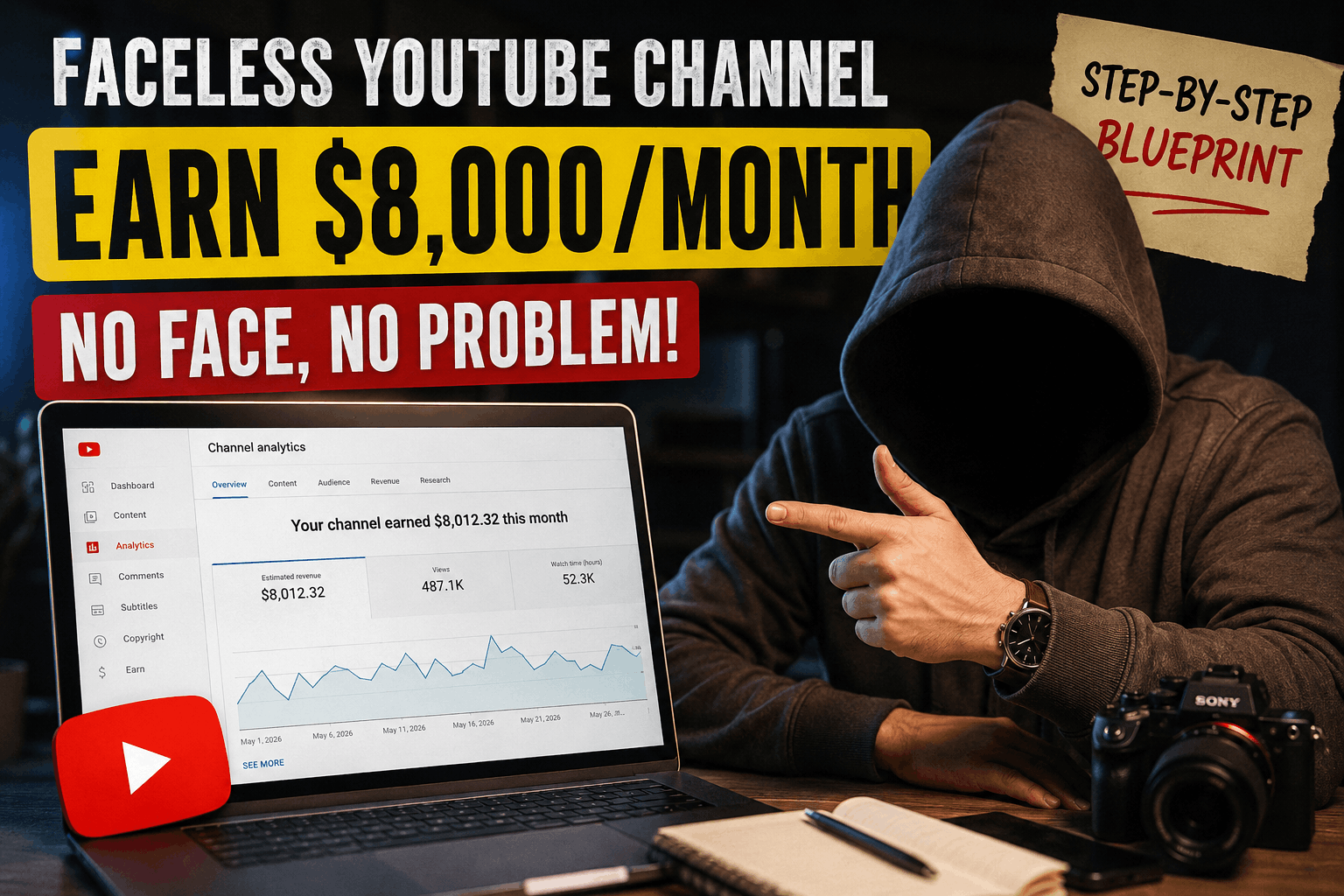
If you’re wondering how to start a faceless YouTube channel without expensive equipment or prior experience, this guide will walk you through every step.
How to start a faceless YouTube channel is one of the most searched ways to build an online business in 2026. Thanks to AI tools, YouTube automation, and beginner-friendly video editing software, you can create high-quality videos, grow an audience, and earn money on YouTube without ever showing your face.
If you’ve ever wondered whether it’s possible to build a successful YouTube channel while staying behind the scenes, the answer is yes. Thousands of creators are generating passive income using faceless YouTube channels by publishing educational videos, tutorials, documentaries, storytelling content, finance videos, technology reviews, and AI-generated content.
The biggest misconception is that success on YouTube depends on expensive cameras, professional studios, or becoming an influencer. In reality, viewers care far more about valuable content than seeing the creator’s face.
In this complete guide, you’ll learn how to start a faceless YouTube channel step by step—from choosing a profitable niche and creating engaging videos to optimizing your content for YouTube SEO and building multiple income streams.
Whether you’re a complete beginner or looking to automate your existing YouTube workflow, this guide will help you avoid common mistakes and build a channel designed for long-term growth.
What You’ll Learn
- How to choose a profitable YouTube niche
- The best AI tools for creating faceless videos
- How to write engaging scripts that keep viewers watching
- Ways to avoid copyright and monetization problems
- How to optimize videos using YouTube SEO
- How successful creators scale faceless YouTube businesses
- Different ways to monetize your YouTube channel
Why Start a Faceless YouTube Channel in 2026?
Before learning how to start a faceless YouTube channel, it’s important to understand why this business model has become so popular.
Artificial intelligence has completely changed how content is created. Today, one person can research topics, write scripts, generate voiceovers, edit videos, design thumbnails, and publish professional content in a fraction of the time it took just a few years ago.
This has created enormous opportunities for creators who want to build digital assets instead of becoming internet celebrities.
Unlike traditional YouTube channels, faceless channels offer several unique advantages:
- No camera anxiety or public exposure.
- Lower startup costs.
- Easier outsourcing and automation.
- The ability to run multiple channels simultaneously.
- Greater privacy while building an online business.
Another major advantage is scalability. Once you’ve created an efficient workflow, you can delegate tasks such as script writing, voiceovers, video editing, and thumbnail design while focusing on strategy and growth.
Many successful YouTube entrepreneurs manage several channels at the same time using small remote teams and clearly defined systems.
To learn more about YouTube best practices, visit the YouTube Creator Academy, where Google provides free training for content creators.
The Importance of Choosing a High-RPM Niche
One of the biggest factors affecting your YouTube income is RPM (Revenue Per Mille), which represents how much revenue you earn for every 1,000 monetized views.
Not all YouTube niches generate the same advertising revenue.
For example, finance, investing, software, artificial intelligence, business, and digital marketing often have much higher RPMs than general entertainment or meme-based content because advertisers are willing to pay more to reach those audiences.
This means two channels receiving the same number of views can generate completely different amounts of revenue depending on their niche.
Choosing a profitable niche from the beginning gives your channel a much stronger foundation for long-term success.
Step 1: Choose the Right Niche for Your Faceless YouTube Channel
The first step in learning how to start a faceless YouTube channel is selecting a niche that combines audience demand, long-term content opportunities, and strong monetization potential.
Many beginners choose topics they personally enjoy without checking whether those topics have enough search demand or advertiser interest. Instead, your goal should be finding a niche that people actively search for while also offering multiple ways to generate revenue.
Best High-RPM Faceless YouTube Niches
If your objective is building a profitable business, these niches consistently perform well:
- Artificial Intelligence – AI tools, ChatGPT tutorials, automation software, productivity apps, and future technology.
- Personal Finance – Investing, budgeting, credit cards, side hustles, passive income, and wealth-building strategies.
- Technology Reviews – Software comparisons, gadgets, apps, SaaS platforms, and tutorials.
- Business & Entrepreneurship – Online business ideas, freelancing, marketing strategies, and startup advice.
- Educational Content – How-to tutorials, skill development, career advice, and productivity tips.
- Documentary & Storytelling – Historical events, mysteries, biographies, and educational storytelling videos.
Each of these niches provides consistent content ideas while attracting advertisers willing to pay higher rates.
Use the Outlier Strategy to Find Winning Video Ideas
One of the smartest ways to grow quickly is by identifying outlier videos.
An outlier video performs significantly better than the rest of a creator’s content. For example, if most videos receive 10,000 views but one reaches 500,000 or even one million views, there is usually a reason.
Study successful outlier videos by analyzing:
- Titles
- Thumbnail design
- Opening hook
- Video structure
- Audience comments
- Average video length
Don’t copy these videos. Instead, understand what viewers found valuable and create a better, more up-to-date version using your own research and perspective.
This strategy allows you to build on proven audience demand while creating original content that aligns with YouTube’s recommendations.
Validate Your Niche Before Publishing
Before creating your first video, answer these questions:
- Can you create at least 100 unique video ideas?
- Is there consistent search demand throughout the year?
- Are advertisers actively spending money in this niche?
- Can you recommend useful affiliate products or services?
- Will you still enjoy creating content about this topic six months from now?
If you can confidently answer “yes” to each question, you’ve likely chosen a niche with excellent long-term potential.
💡 Pro Tip
Instead of chasing viral trends, build a library of evergreen content that continues attracting views for months or years. Evergreen videos create predictable traffic, improve YouTube SEO, and generate passive income long after they’re published.
Step 2: Plan Your Content and Write Engaging Video Scripts
After selecting your niche, the next step in learning how to start a faceless YouTube channel is creating content that keeps viewers watching from beginning to end. A successful video doesn’t start with editing—it starts with a well-researched script.
Many beginners make the mistake of writing scripts around what they want to say instead of what viewers want to learn. The best-performing YouTube videos solve a problem, answer a question, or satisfy curiosity within the first few seconds.
Research Topics Before Writing
Never create videos based only on assumptions. Instead, validate every idea before writing your script.
Research your topic using:
- YouTube Search suggestions
- Google Search
- Google Trends
- People Also Ask questions
- VidIQ or TubeBuddy keyword research
- Competitor videos and comments
Reading viewer comments is one of the easiest ways to discover unanswered questions and create videos people are already searching for.
You can also use Google Trends to identify growing topics before creating your videos.
Use AI to Speed Up Script Writing
Modern AI tools can dramatically reduce the time required to research and draft scripts. Tools like ChatGPT and Claude are excellent for brainstorming, outlining videos, and generating first drafts.
However, never copy AI-generated content without editing it.
Always review your script carefully, verify facts, improve transitions, and add examples or personal insights. This helps your videos feel more natural while improving originality and viewer trust.
Think of AI as your assistant—not your replacement.
Create a Strong Hook
The first 15–30 seconds determine whether someone keeps watching or clicks away.
Avoid long introductions or talking about yourself. Instead, immediately explain the value viewers will receive.
For example:
“Imagine building a YouTube channel that earns money every month without ever showing your face. In this guide, you’ll learn exactly how to start a faceless YouTube channel using AI tools and proven YouTube growth strategies.”
This type of opening creates curiosity while clearly communicating the video’s purpose.
Structure Every Script for Better Audience Retention
A simple structure makes videos easier to follow and keeps viewers engaged.
- Hook – Capture attention immediately.
- Problem – Explain why the topic matters.
- Solution – Deliver clear, actionable advice.
- Examples – Support your points with real-world scenarios.
- Summary – Reinforce the key takeaways.
- Call-to-Action – Encourage viewers to subscribe or watch another video.
This structure improves watch time and helps YouTube understand that viewers enjoy your content.
After choosing your niche, you’re ready to continue learning how to start a faceless YouTube channel by creating engaging content.
Step 3: Record Voiceovers and Create Professional Videos
One of the biggest advantages of learning how to start a faceless YouTube channel is that you don’t need expensive cameras or professional recording equipment.
Instead, your focus should be on delivering clear narration supported by engaging visuals.
Choose Between AI and Human Voiceovers
Both AI-generated voices and human narration can produce excellent results.
If you’re just starting, AI voice generators provide an affordable way to create consistent voiceovers. As your channel grows, you may choose to hire professional voice artists to develop a stronger brand identity.
Whichever option you choose, make sure the narration sounds natural, conversational, and easy to understand.
Best Tools for Voiceovers
- ElevenLabs
- Murf AI
- PlayHT
- Microsoft AI Voices
Always listen to the completed narration before editing your video. Adjust pronunciation, pauses, and pacing wherever necessary.
Edit Videos That Keep People Watching
Great editing isn’t about using dozens of flashy effects. It’s about keeping viewers interested throughout the video.
Use a combination of:
- Stock footage
- Animations
- Motion graphics
- Screen recordings
- Text overlays
- Charts and infographics
- Relevant images
Changing visuals every few seconds helps maintain audience retention without overwhelming viewers.
Recommended Video Editing Software
- CapCut
- DaVinci Resolve
- Adobe Premiere Pro
- Final Cut Pro
- Filmora
Choose software based on your experience and budget. Even free editors can produce professional-looking videos when used effectively.
Where to Find Copyright-Free Footage
Using copyrighted footage without permission can lead to claims, demonetization, or video removal. Always use licensed or royalty-free assets.
Popular sources include:
- Pexels
- Pixabay
- Unsplash
- Storyblocks
- Envato Elements
- Motion Array
Whenever possible, combine stock footage with your own graphics, animations, and commentary to create original content that provides unique value.
Create Click-Worthy Thumbnails
Even the best video won’t succeed if nobody clicks on it. Your thumbnail and title work together to improve your click-through rate (CTR).
High-performing thumbnails usually include:
- Large readable text
- Strong colour contrast
- One clear subject
- Minimal distractions
- Curiosity without being misleading
Remember, your thumbnail should encourage curiosity while accurately representing the content of your video.
💡 Quick Tip
Before publishing every video, ask yourself one question: “Would I click this thumbnail if it appeared on my YouTube homepage?” If the answer is no, redesign it before uploading.
Step 4: Publish Your Videos and Optimize for YouTube SEO
Creating great content is only half the journey. Once you’ve learned how to start a faceless YouTube channel, you also need to make sure people can actually find your videos. This is where YouTube SEO becomes essential.
YouTube is the world’s second-largest search engine, and its algorithm relies on many of the same principles as Google. Videos that match user intent, keep viewers engaged, and generate positive interactions are far more likely to be recommended.
Write Search-Friendly Video Titles
Your title should clearly explain what viewers will learn while encouraging them to click. Avoid misleading clickbait because it often results in poor audience retention.
Good video titles usually:
- Include the primary keyword naturally.
- Focus on solving one specific problem.
- Create curiosity without exaggeration.
- Remain under approximately 60 characters when possible.
Example:
How to Start a Faceless YouTube Channel in 2026 (Beginner Guide)
Optimize Your Video Description
Your description helps YouTube understand your content while providing additional context for viewers.
A good description should include:
- A natural introduction using your target keyword.
- A summary of what viewers will learn.
- Links to recommended resources.
- Relevant timestamps for longer videos.
- A clear call-to-action encouraging viewers to subscribe.
Avoid stuffing keywords. Instead, write naturally and focus on helping viewers understand what the video covers.
Use Chapters to Improve User Experience
Adding timestamps allows viewers to jump directly to the information they need.
Video chapters also improve user experience and can increase watch time because viewers are more likely to stay on your video instead of leaving to find another source.
Focus on Audience Retention
One of the strongest ranking signals on YouTube is audience retention.
If viewers continue watching your videos, YouTube assumes your content provides value and recommends it to more people.
Improve retention by:
- Removing unnecessary introductions.
- Changing visuals regularly.
- Using pattern interrupts every 15–30 seconds.
- Answering questions quickly.
- Keeping your pacing energetic and engaging.
💡 Pro Tip
Instead of asking viewers to subscribe within the first few seconds, provide value first. After solving a problem or sharing useful information, viewers are much more likely to subscribe naturally.
Once you understand how to start a faceless YouTube channel, monetization becomes much easier because you’ll already have a consistent content strategy.
Step 5: Monetize Your Faceless YouTube Channel
After learning how to start a faceless YouTube channel, the next goal is turning your content into a sustainable income stream.
Many beginners believe AdSense is the only way to make money on YouTube. In reality, successful creators build multiple income streams so they’re not dependent on advertising revenue alone.
1. YouTube Partner Program
Once your channel meets YouTube’s current monetization requirements, you can apply to the YouTube Partner Program and start earning revenue from advertisements displayed on your videos.
The amount you earn depends on factors such as your niche, audience location, watch time, and advertiser demand.
Before applying for monetization, review the official YouTube Partner Program requirements.
2. Affiliate Marketing
Affiliate marketing is one of the easiest ways to increase your revenue.
Recommend products or services that genuinely help your audience and include your affiliate links in the video description.
Popular affiliate categories include:
- AI software
- Web hosting
- Video editing tools
- SEO software
- Productivity apps
- Online courses
3. Sponsorships
As your audience grows, companies may approach you to promote their products or services.
Choose sponsorships carefully and only recommend brands that are relevant to your audience and align with your content.
4. Sell Digital Products
Creating digital products allows you to earn income beyond advertising.
Examples include:
- eBooks
- Templates
- Prompt libraries
- Online courses
- Premium communities
- Checklists and guides
Digital products can become one of the highest-margin revenue streams for content creators.
5. Offer Services
If your videos demonstrate expertise, viewers may hire you for consulting, coaching, freelance work, or business services.
This is particularly effective in niches such as SEO, AI, marketing, web development, finance, and online business.
Common Mistakes to Avoid
Many creators fail not because they lack talent, but because they make avoidable mistakes early in their YouTube journey.
- Choosing the wrong niche. Pick a niche with long-term demand and strong monetization opportunities.
- Publishing inconsistent content. Consistency builds trust with both viewers and the YouTube algorithm.
- Ignoring analytics. Use YouTube Studio to understand what is and isn’t working.
- Copying competitors. Study successful creators for inspiration, but always produce original content.
- Poor thumbnails. Great videos still need compelling thumbnails to earn clicks.
- Giving up too early. Most successful channels take months of consistent effort before gaining momentum.
Frequently Asked Questions About Starting a Faceless YouTube Channel
Can I start a faceless YouTube channel for free?
Yes. You can start a faceless YouTube channel with little or no investment by using free tools for script writing, video editing, graphic design, and royalty-free stock footage. As your channel grows, upgrading to premium software can improve production quality and save time, but it isn’t required to launch your first videos.
Is a faceless YouTube channel profitable?
Absolutely. Many successful creators earn income through the YouTube Partner Program, affiliate marketing, sponsorships, digital products, and online courses. Your earnings depend on your niche, audience location, content quality, and publishing consistency rather than whether you appear on camera.
Which niche is best for a faceless YouTube channel?
High-performing niches include Artificial Intelligence, Personal Finance, Technology, Business, Productivity, Education, Storytelling, History, Motivation, and Software Tutorials. Choose a niche that has long-term search demand, strong advertiser interest, and enough content ideas to sustain your channel for years.
How often should I upload videos?
Consistency is more important than frequency. Publishing one or two high-quality videos every week is usually better than uploading daily with inconsistent quality. Create a realistic schedule that you can maintain over the long term.
Can I use AI to create YouTube videos?
Yes. AI tools can help with research, script writing, voice generation, subtitle creation, thumbnail design, and video editing. However, always review AI-generated content carefully, verify facts, and add your own insights to create original, valuable videos that comply with YouTube’s monetization policies.
How long does it take to monetize a faceless YouTube channel?
Every channel grows at a different pace. Some creators achieve monetization within a few months, while others take longer. Success depends on creating valuable content, improving audience retention, optimizing for YouTube SEO, and publishing consistently.
Recommended AI Tools for Faceless YouTube Channels
| Purpose | Recommended Tools |
|---|---|
| Keyword Research | VidIQ, TubeBuddy |
| Script Writing | ChatGPT, Claude |
| AI Voiceovers | ElevenLabs, Murf AI, PlayHT |
| Video Editing | CapCut, DaVinci Resolve, Adobe Premiere Pro |
| Thumbnail Design | Canva, Adobe Express |
| Stock Footage | Pexels, Pixabay, Storyblocks, Envato Elements |
Final Thoughts
If you’ve been wondering how to start a faceless YouTube channel, the answer is simple: start today.
You don’t need expensive equipment, professional editing skills, or millions of subscribers to begin. What you need is a clear niche, valuable content, a consistent publishing schedule, and the willingness to improve with every upload.
Focus on helping your audience, create original content, use AI tools responsibly, and optimize every video for YouTube SEO. Over time, your content library can become a valuable digital asset that generates traffic, authority, and multiple streams of income.
The creators who succeed aren’t always the most talented—they’re the ones who stay consistent, learn from their analytics, and never stop improving.
Now that you know exactly how to start a faceless YouTube channel, it’s time to publish your first video and begin building your YouTube business.
Continue Learning with ClickMe4Help
If you found this guide helpful, explore more beginner-friendly tutorials on ClickMe4Help covering:
- AI Tools for Content Creators
- WordPress Tutorials
- SEO Guides
- Affiliate Marketing Strategies
- Blogging Tips
- YouTube Growth Tutorials
- Google AdSense Guides
If you’re building a long-term online business, don’t rely on YouTube alone. Browse our Blog for additional guides on blogging, AI, WordPress, and digital marketing. Our goal is to help beginners build profitable online businesses using practical, easy-to-follow strategies.